
If you’re wondering ERP vs CRM: Which Is Better, the answer depends on your business needs. CRM is best for managing customers and sales, while ERP helps manage finance, inventory, operations, and production. In this guide, you’ll learn the key differences, benefits, use cases, pricing, and how to choose the right software.
ERP vs CRM: Which Is Better?
Choosing the right business software is one of the biggest decisions for any company. Whether you own a startup, a small business, or a large company, using the right software can save time, reduce mistakes, increase profits, and improve customer satisfaction.
Two of the most popular business software solutions are ERP (Enterprise Resource Planning) and CRM (Customer Relationship Management).
Many business owners ask the same question:
“ERP vs CRM: Which is better?”
The answer is simple:
It depends on your business needs.
In this detailed guide, you’ll learn:
Table of Contents
By the end of this article, you’ll know exactly which solution is best for your business.
What is ERP?
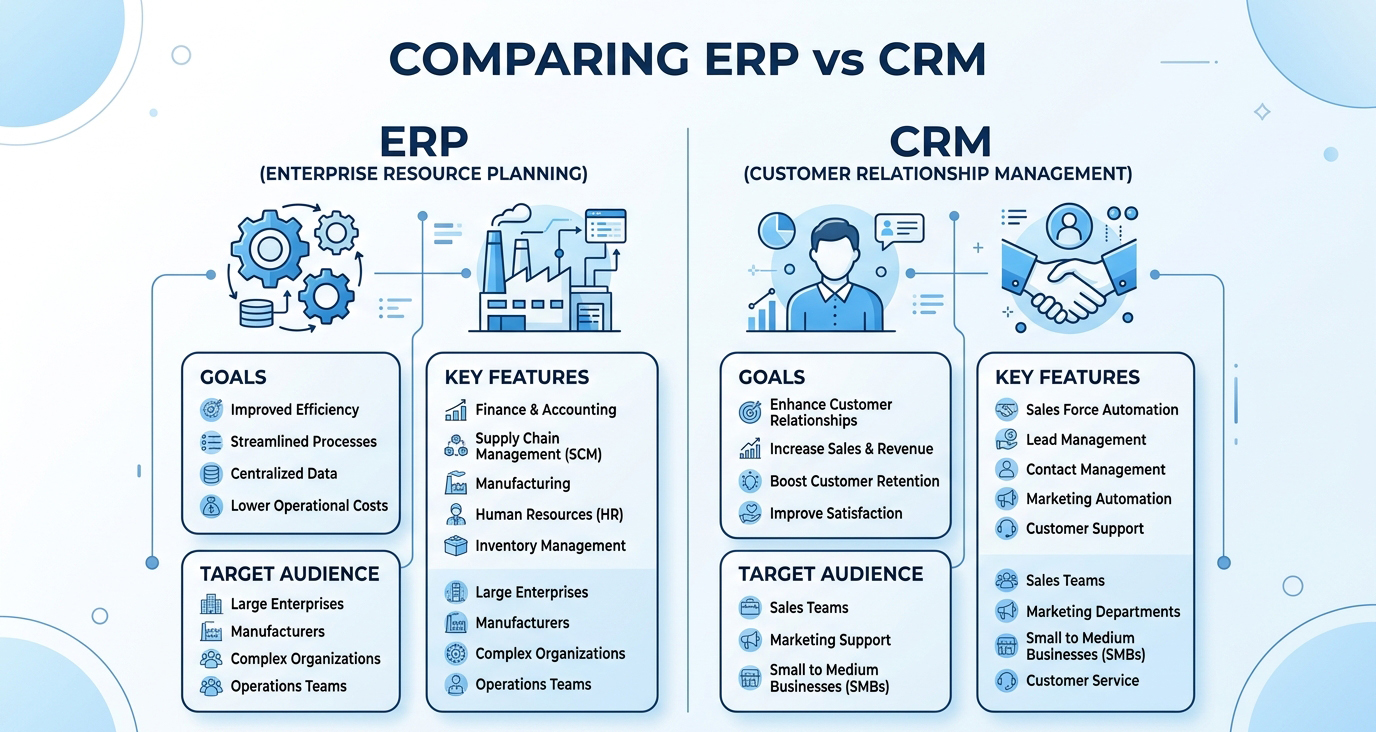
ERP stands for Enterprise Resource Planning.
It is software that helps businesses manage their daily operations from one central system.
Instead of using separate software for finance, inventory, HR, sales, and purchasing, ERP connects everything together.
ERP manages:
- Inventory
- Accounting
- Human Resources
- Manufacturing
- Purchasing
- Supply Chain
- Warehouse
- Finance
- Payroll
- Reporting
Think of ERP as the brain of a company.
It keeps every department connected.
What is CRM?
CRM stands for Customer Relationship Management.
CRM focuses only on customers.
It helps businesses manage:
- Leads
- Sales
- Customer information
- Follow-ups
- Emails
- Customer support
- Marketing campaigns
- Customer history
Think of CRM as the heart of your sales team.
It helps businesses build better relationships with customers.
ERP vs CRM: Quick Comparison Table
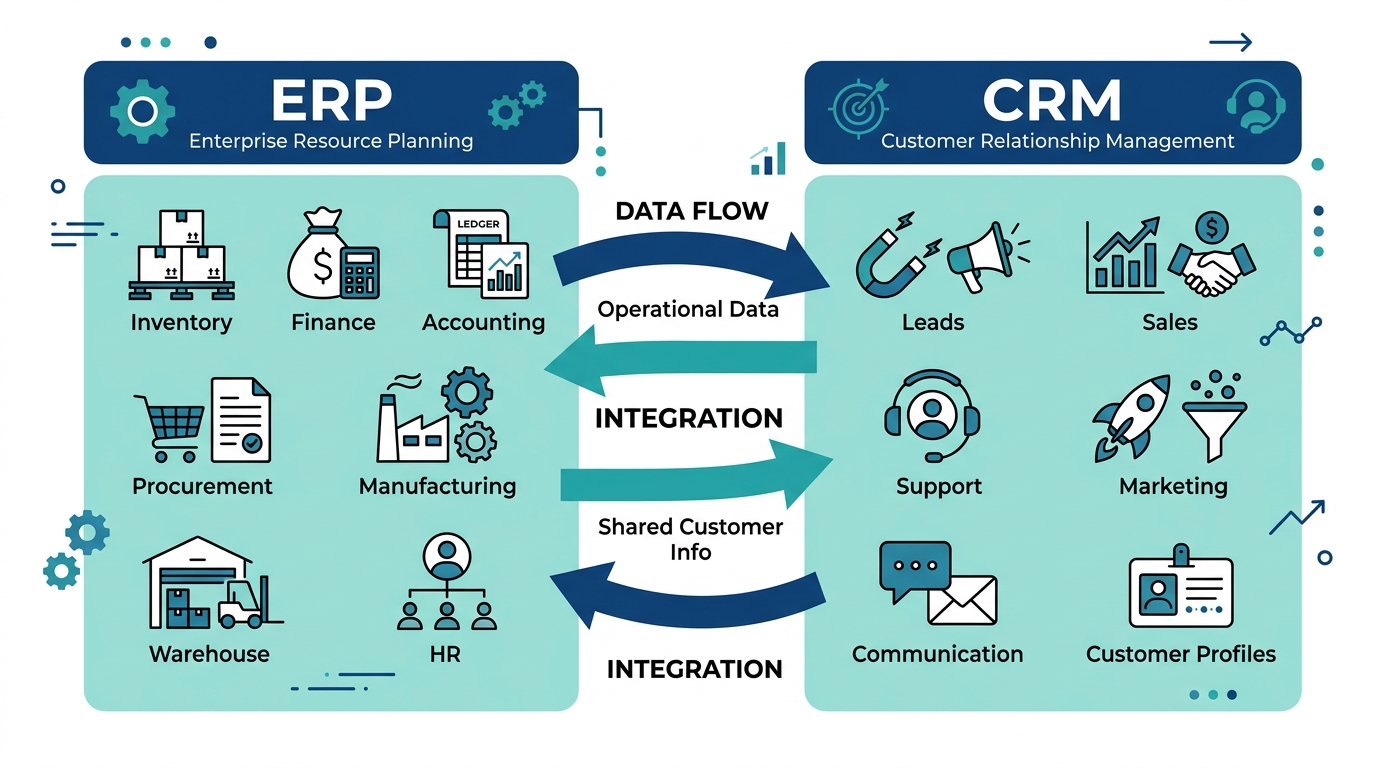
| Feature | ERP | CRM |
|---|---|---|
| Main Focus | Business Operations | Customer Relationships |
| Users | Finance, HR, Inventory, Operations | Sales, Marketing, Customer Support |
| Goal | Improve internal processes | Increase sales and customer satisfaction |
| Best For | Medium and large businesses | Businesses of all sizes |
| Departments Covered | Multiple departments | Customer-facing teams |
| Inventory Management | Yes | No |
| Sales Tracking | Basic | Advanced |
| Customer Support | Limited | Excellent |
| Reporting | Business reports | Sales reports |
ERP vs CRM: Major Differences
1. Purpose
ERP manages the entire business.
CRM manages customer relationships.
2. Main Users
ERP is used by:
- HR
- Finance
- Inventory
- Manufacturing
- Purchase Department
CRM is used by:
- Sales Team
- Marketing Team
- Customer Support
3. Business Goal
ERP improves efficiency.
CRM improves customer experience.
4. Data Management
ERP stores business data.
CRM stores customer data.
5. Revenue Impact
ERP reduces costs.
CRM increases sales.
Benefits of ERP Software
ERP offers many advantages.
Better Productivity
Employees spend less time doing manual work.
One Central Database
Everything stays in one place.
No duplicate data.
Better Inventory Management
Businesses know exactly:
- What is in stock
- What needs ordering
- Which products sell the most
Improved Financial Management
Finance reports become accurate.
Taxes become easier.
Payroll becomes faster.
Better Decision Making
Managers can view real-time reports.
This helps them make smarter business decisions.
Benefits of CRM Software
CRM also provides excellent benefits.
Better Customer Relationships
Every customer interaction is recorded.
Businesses know customer preferences.
Higher Sales
Sales teams never forget follow-ups.
Leads become paying customers.
Better Customer Service
Support teams solve problems faster.
Happy customers return again.
Marketing Automation
Businesses can send:
- Emails
- SMS campaigns
- Offers
- Promotions
Automatically.
Sales Forecasting
CRM predicts future sales using customer data.
Which Businesses Should Choose ERP?
ERP is ideal for businesses with many departments.
Examples include:
- Manufacturing companies
- Hospitals
- Schools
- Construction companies
- Wholesale businesses
- Large retailers
- Logistics companies
If your business struggles with inventory, finance, payroll, or operations, ERP is a better choice.
Which Businesses Should Choose CRM?
CRM is ideal for businesses that depend on customers.
Examples include:
- Digital marketing agencies
- Software companies
- Real estate firms
- Insurance agencies
- Educational institutes
- Travel companies
- Consultants
- Freelancers
If your goal is to generate more leads and improve customer relationships, CRM is the right solution.
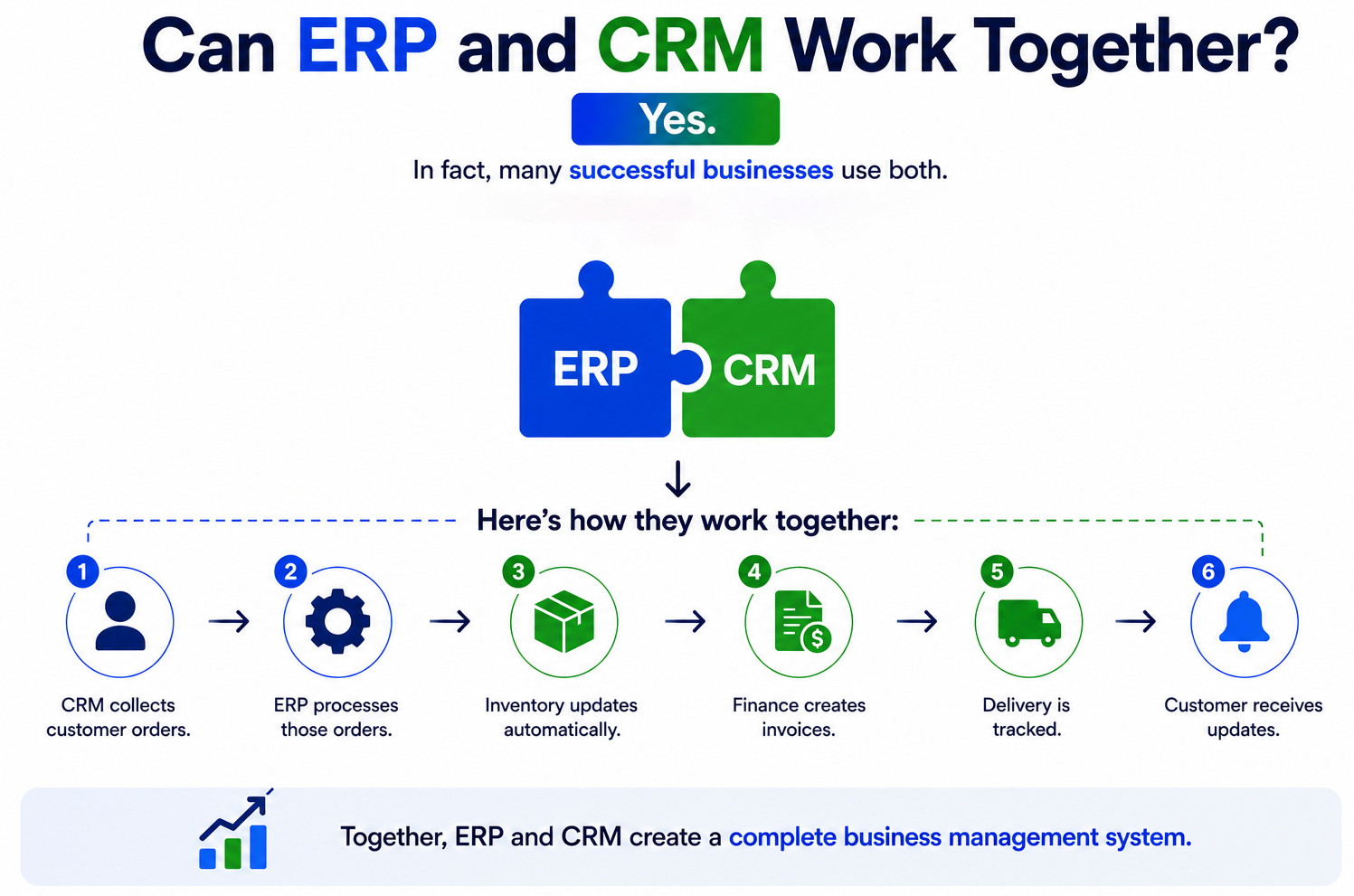
Can ERP and CRM Work Together?
Yes.
In fact, many successful businesses use both.
Here’s how they work together:
CRM collects customer orders.
↓
ERP processes those orders.
↓
Inventory updates automatically.
↓
Finance creates invoices.
↓
Delivery is tracked.
↓
Customer receives updates.
Together, ERP and CRM create a complete business management system.
Real-Life Example from India
Imagine Rahul, a small business owner from Jaipur.
He runs a furniture manufacturing business.
Initially, Rahul managed:
- Orders in Excel
- Inventory on paper
- Customer details in WhatsApp
- Accounts manually
As his business grew, mistakes increased.
Products went out of stock.
Customers complained about delayed deliveries.
Rahul first implemented a CRM system.
His sales team started tracking every lead and customer follow-up.
Sales increased by 25% within a few months because no customer inquiry was missed.
Later, Rahul implemented an ERP system.
Now:
- Inventory updates automatically
- Bills are generated instantly
- Employees receive salaries on time
- Financial reports are ready in minutes
Today, Rahul’s business operates more smoothly, and he spends less time on paperwork and more time growing his company.
This example shows that CRM helped Rahul increase sales, while ERP helped him manage operations efficiently.
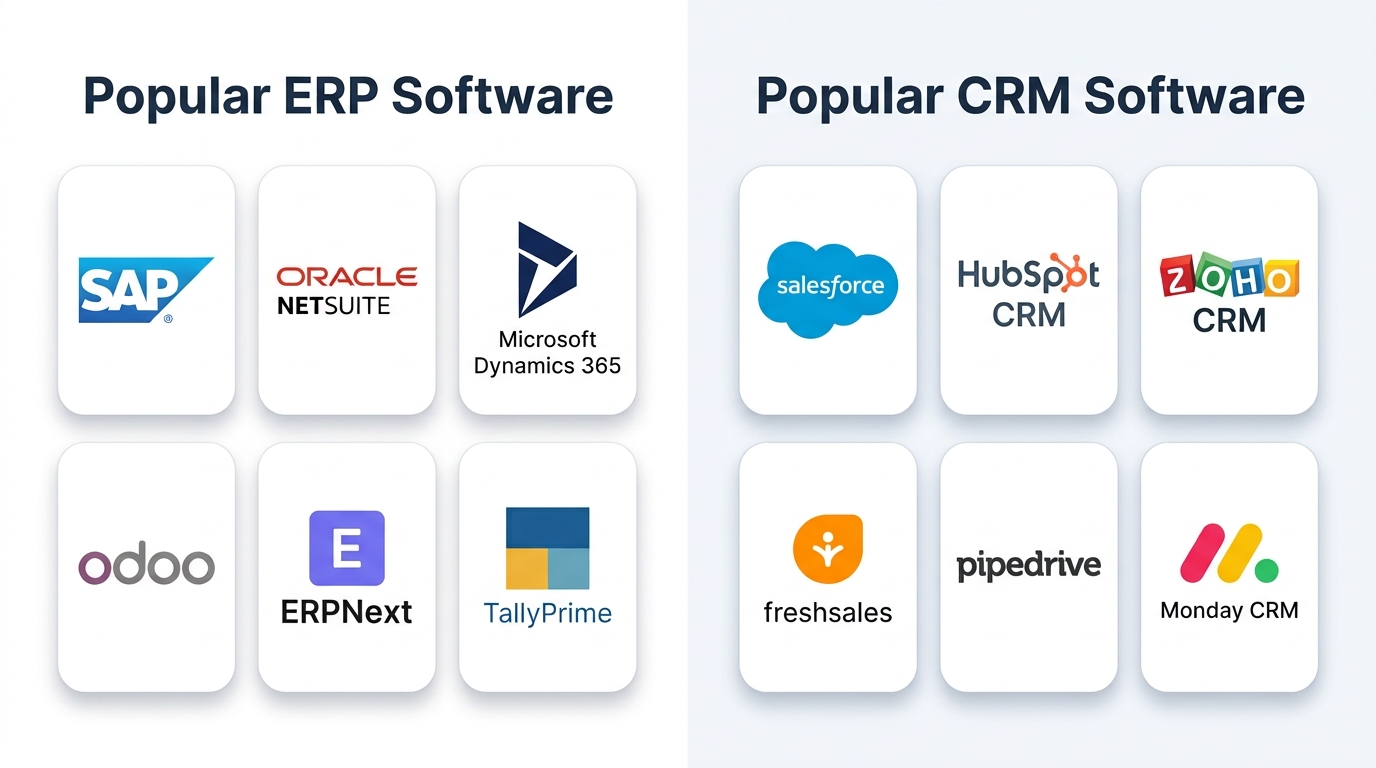
Popular ERP Software
Some well-known ERP solutions include:
Popular CRM Software
Popular CRM options include:
- Salesforce
- HubSpot CRM
- Zoho CRM
- Freshsales
- Pipedrive
- Monday CRM
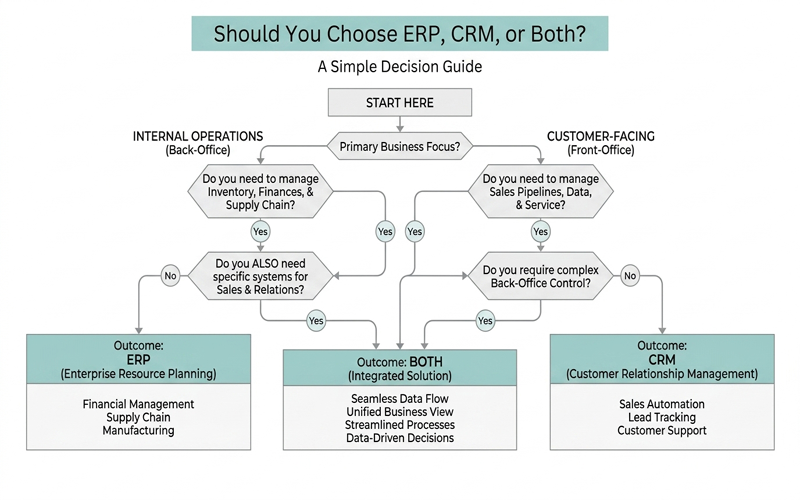
ERP vs CRM: Which One Should You Choose?
Choose ERP if you want to:
- Manage inventory
- Handle finance
- Improve operations
- Manage employees
- Track production
- Reduce operational costs
Choose CRM if you want to:
- Increase sales
- Generate more leads
- Improve customer service
- Track customer interactions
- Automate marketing
- Build long-term customer relationships
Choose both ERP and CRM if:
- Your business is growing quickly.
- You have multiple departments.
- You manage many customers.
- You want one connected business system.
Common Mistakes to Avoid
Many businesses make these mistakes:
- Buying software without understanding business needs.
- Choosing the cheapest option instead of the most suitable one.
- Ignoring employee training.
- Not planning data migration properly.
- Failing to define business goals before implementation.
Avoiding these mistakes can save both time and money.
Step-by-Step Guide Before Buying ERP or CRM
Step 1
Identify your business challenges.
Step 2
List the features you need.
Step 3
Set your budget.
Step 4
Request a free demo.
Step 5
Compare at least three software options.
Step 6
Check customer reviews.
Step 7
Ensure the software can grow with your business.
Step 8
Train your employees before implementation.
Frequently Asked Questions (FAQs)
ERP vs CRM What Is The Difference?
The main difference between ERP (Enterprise Resource Planning) and CRM (Customer Relationship Management) is their purpose. An ERP system helps businesses manage internal operations such as finance, inventory, purchasing, manufacturing, and human resources. In contrast, a CRM system focuses on managing customer relationships, sales, marketing, and customer support.
Can a small business use CRM?
Yes. CRM is an excellent choice for startups and small businesses because it helps manage leads, improve customer relationships, and increase sales.
Do I need ERP if I already have CRM?
If your business is growing and you need better control over inventory, finance, or operations, adding an ERP system can be a smart decision.
Is ERP more expensive than CRM?
In most cases, yes. ERP systems usually include more modules and require more setup, making them costlier than CRM solutions.
Can ERP and CRM be integrated?
Yes. Many modern platforms allow ERP and CRM to work together, providing a complete view of both business operations and customer activities.
Can ERP replace CRM?
No, ERP cannot completely replace CRM because both systems serve different business purposes. ERP (Enterprise Resource Planning) is designed to manage internal operations such as finance, inventory, purchasing, manufacturing, and human resources. CRM (Customer Relationship Management), on the other hand, focuses on managing customer interactions, sales, marketing, and customer support.
Best Choice Based on Business Type
| Business Type | Recommended Software |
|---|---|
| Startup | CRM |
| Freelancer | CRM |
| Digital Agency | CRM |
| Retail Store | ERP |
| Manufacturing | ERP |
| Hospital | ERP |
| School or College | ERP |
| Real Estate | CRM |
| Software Company | CRM + ERP |
| Large Enterprise | ERP + CRM |
Conclusion
When comparing ERP vs CRM: Which is Better, there is no single winner. The right choice depends on your business goals.
If your biggest challenge is managing inventory, finances, employees, and daily operations, an ERP system is the better option.
If your main goal is to attract more customers, improve sales, and build stronger relationships, a CRM system is the ideal choice.
For growing businesses, combining ERP and CRM often delivers the best results. CRM helps you win more customers, while ERP ensures your business can efficiently deliver products and services. Together, they create a strong foundation for long-term growth and success.
Ready to Implement the Right ERP or CRM for Your Business?
Whether you need an integrated ERP system, a tailored CRM pipeline, or custom software development, our team at InfoShareTech is ready to guide you.
Get a Free Consultation →